Typst tools
Three tools built around Typst for typography, automation and print production.
- Typst
- Rust
- Python
- Typography
I have spent years working with publishing tools — from InDesign and LaTeX to CHILI publisher. I discovered Typst through my work around web-to-publish at netzwerk P. It feels like a rare fresh start: open source, fast, programmable and full of potential. That is why I am building the tools I still miss in real production workflows.
Context
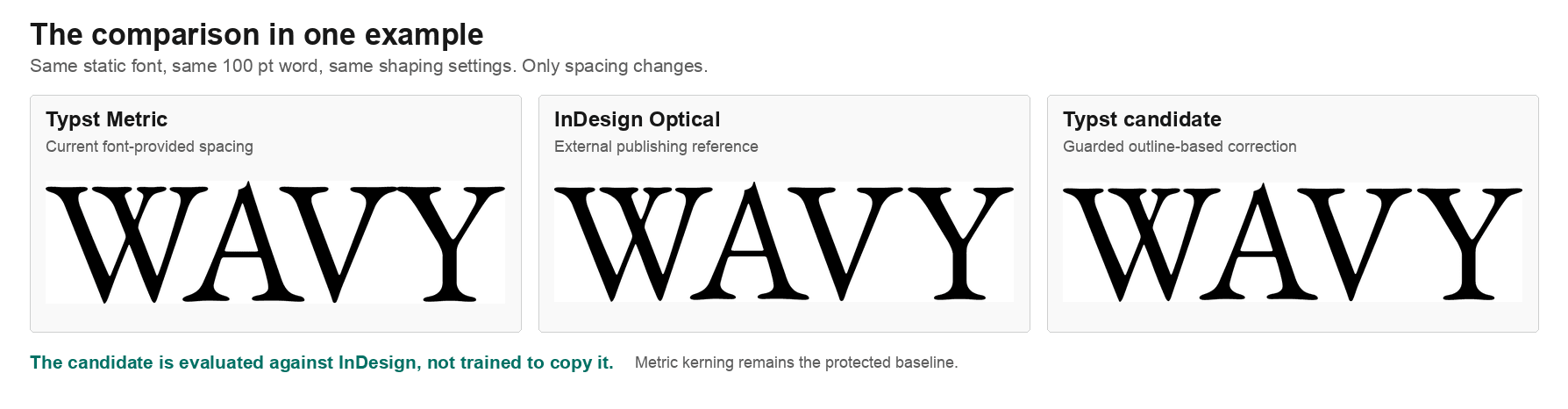
Typst combines modern publishing with programmable documents. Practical production still leaves gaps around optical kerning, print imposition and fitting variable text into fixed frames.
Motivation
These three tools bring my work with typography, workflows and code together in small, clearly bounded systems.
Approach
The Optical Kerning Bench makes results reproducibly comparable. Sheetwise provides Typst-native imposition. Framefit fits variable text into fixed frames in a controlled way.
Features
- Optical Kerning Bench for reproducible typography experiments
- Sheetwise for Typst-native print imposition
- Framefit for variable text in fixed frames
- Small, clearly bounded tools for real publishing workflows
Current state
Sheetwise and Framefit are public MIT-licensed packages at version 0.1.0. The Kerning Bench is active research and does not yet carry a general open-source licence.